Send the right details first and you make the review process a lot easier. If you want to share a festival tip, a concert announcement, or a music-news update with Guieiro, the goal is simple: give the editor enough context to understand the story without making them dig through a small avalanche of text.
People usually ask the same four questions before they hit send: What should I include? How much detail is enough? What happens after I submit? And what should I leave out? The short version is that a good tip is clear, specific, and easy to verify. That advice lines up with basic email etiquette guidance and the broader netiquette rulebook, which both reward clean structure and responsible contact practices.
This page is a practical guide to the submission workflow. You will learn what kinds of tips are welcome, which details matter most, how to format the message so it reads cleanly, what timeline to expect after you send it, and how to avoid oversharing sensitive information. If you are unsure where a question belongs, use the contact page or read about Guieiro to understand the site’s focus before you write.
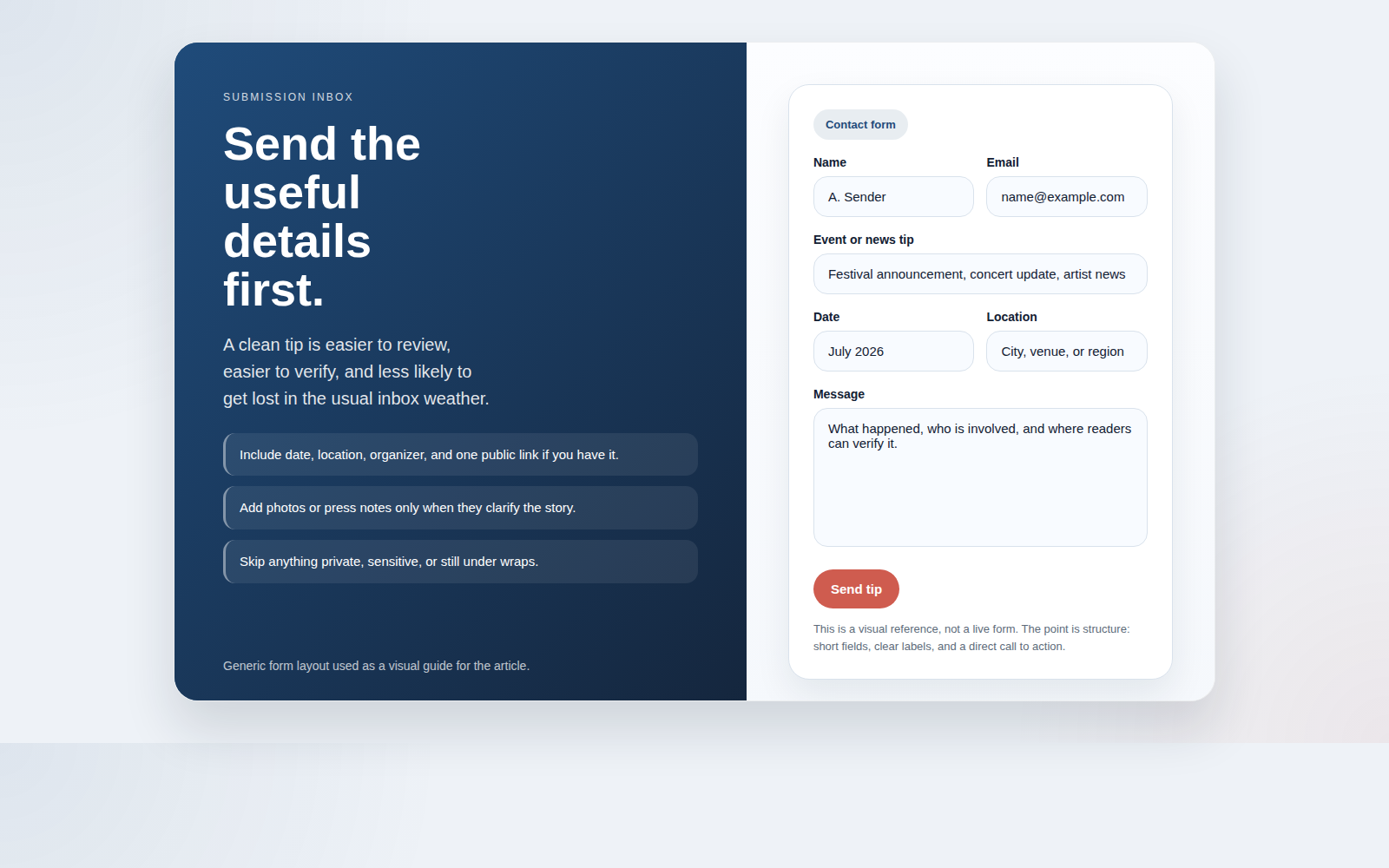
What you can submit
Guieiro works best when the tip is tied to live music, scene updates, or artist activity that readers can actually act on. The most useful submissions usually fall into a few clear buckets:
- Music festivals – new announcements, lineup changes, schedule updates, ticket details, or venue changes.
- Concert announcements – tour stops, local shows, added dates, or important event revisions.
- Artist news – releases, collaborations, live sessions, interview opportunities, or public project updates.
- Other music-related events – showcases, listening parties, livestreams, workshops, and community events with a public music angle.
If your tip is about something bigger than a single event, that is fine too. A short paragraph that explains the context is usually enough. The trick is not volume. It is signal. The editor needs to know what happened, when it happens, where it matters, and why the tip is worth a reader’s time.
How to tailor the tip
Different submission types need slightly different emphasis. The basic structure stays the same, but the lead detail changes depending on the story.
- Festival tip – lead with the dates, city, and official lineup or ticket page if one exists.
- Concert announcement – lead with the artist, venue, and date, then add the public link readers can use.
- Artist news – lead with the release, collaboration, or announcement itself, then add context and source links.
A useful rule: if the tip would make sense in a calendar, put the date first. If it would make sense in a feed, put the headline first. If it would make sense in both, you are probably close to the right shape.
Minimum details required
At minimum, send the four things that let someone verify the tip without a second round of detective work. I treat this like the base layer of the submission. Without it, the message is just noise in a nice outfit.
| Detail | Why it matters | Example |
|---|---|---|
| Your name | Gives the team a human reference point and a way to follow up. | Maria Lopez |
| Event date | Shows whether the tip is upcoming, current, or already happened. | August 16, 2026 |
| Event location | Helps readers understand the geographic context quickly. | Vigo, Spain |
| Organizer details | Confirms who is behind the announcement and helps verify the source. | Festival name, promoter, venue, or label |
If you only have one of those fields, the submission is usually too thin. That does not mean you should wait forever. It means you should add the missing pieces before sending. A concise tip with complete basics is far more useful than a dramatic message with half the facts missing.
Optional details that help
Once the essentials are in place, a few extras can move your submission from “interesting” to “easy to use.” These are not required, but they save time and usually improve the odds that the tip can be turned into a public update.
- Lineup details – especially useful for festivals or multi-artist events.
- Links to event pages – the official site, ticket page, venue page, or an artist post.
- Press materials or images – only if they are current, relevant, and safe to share publicly.
- Short background notes – one sentence on why the event matters or what changed.
- Direct contact details – if the organizer wants a follow-up conversation, include the best public route.
Use judgment here. More material is not automatically better. A tidy event page and one strong image can be enough. A folder full of unrelated attachments is not a strategy; it is a storage problem.
How to format your message
The easiest submissions read like a mini brief. Keep the message short, break the facts into bullets, and lead with the part that matters most. The editor should be able to scan the note in a few seconds and know whether it is worth a deeper look.
Here is a clean structure you can copy:
Subject: Festival tip - [event name] in [city]

Hello Guieiro,

Here are the basics:
- Name:
- Event or artist:
- Date:
- Location:
- Organizer:
- Public link:

Optional details:
- Lineup:
- Press photo or image:
- Notes on what changed:

Thanks,
[Your name]
[Best contact email or phone]
Subject lines matter more than people admit. They are the door handle for the whole message. If the subject is vague, the tip may never get read with the care it deserves.
Good subject lines usually look like one of these:
- Festival tip: Atlantic Sound Weekend in A Coruna
- Concert announcement: new date added for [artist name]
- Artist news: new single and video release this Friday
A few rules keep the message readable:
- Use bullet points for clarity instead of one long paragraph.
- Keep it concise so the important facts stand out.
- Include contact information if you want a reply.
- Use plain language and avoid hype. “New show announced” is better than “biggest moment ever.”
If you manage tips for a venue, label, or promoter, the same pattern still works. The message may travel through several people before it becomes public, so the cleaner the input, the less likely the workflow falls apart in a pile of vague follow-ups.
What a strong tip feels like
| Weak version | Stronger version |
|---|---|
| “There is a festival coming up.” | “River Stage Festival takes place in Porto on September 6-7, 2026, and the organizer just posted the full lineup.” |
| “Band announced a show.” | “The band added a single-night concert at Sala Club on August 22, with the venue and ticket link included below.” |
| “New music news.” | “The artist confirmed a new EP release, shared the artwork, and posted the public announcement on their official site.” |
What happens after you send
After you send a tip, the usual process is simple: the team checks the details, decides whether the information is useful for readers, and follows up if something important is missing. There is no guaranteed publication promise here, because reality is not a vending machine. A useful tip can still be delayed if the facts need verification or the timing is off.
Here is the normal shape of the review path:
- Initial read – the submission is checked for topic fit and basic completeness.
- Verification – public details are compared with the source links or organizer information.
- Editorial decision – the team decides whether it becomes a post, a note, or a follow-up question.
- Follow-up – if needed, the editor asks for one or two missing pieces.
- Publication or no publication – some tips become coverage, and some do not. Clear does not mean automatic.
| Stage | What it usually means | What you can do |
|---|---|---|
| Same day | The tip is easy to scan and already includes enough context. | Wait for confirmation or a follow-up question. |
| 1-2 days | The team is checking links, dates, or organizer details. | Keep your inbox open in case something needs clarification. |
| Later | The item is queued, held for timing, or not the right fit right now. | Send an update only if the event or announcement changes in a meaningful way. |
For teams handling a steady stream of submissions, this step is where workflow matters. A small editorial operation can still use AI integration services to connect inbox triage with calendars, task tracking, or publishing tools when the process starts to sprawl. The point is not to automate judgment. The point is to stop useful tips from getting buried under admin drift.
If you have not heard back right away, that does not automatically mean the tip was rejected. It often just means the team is checking details, waiting for context, or sorting the queue. Good information still behaves better when it is easy to validate.
Privacy note
Keep the submission public-facing and practical. Do not send sensitive personal information, private contract details, or confidential venue notes unless you truly need to and understand the risk. A submission should help readers understand the public story, not expose private material that does not belong in a news tip.
- Do not include personal data that is not necessary for follow-up.
- Do not share confidential event plans, private passwords, or internal documents.
- Do not attach files that you would not want quoted or linked publicly.
- Do not assume every message stays private forever; write it as if a public editor may read it carefully.
For a broader safety baseline on email handling, the common phishing pattern is worth keeping in mind, even when the note looks harmless on the surface. The useful habit is the same: check the source, share only what is necessary, and keep the message clean.
A simple submission checklist
- What is the event, release, or news item?
- When does it happen?
- Where does it happen?
- Who is organizing it?
- What link lets the reader verify it?
- What should stay private?
If you can answer those six questions, you are already ahead of most inbox traffic. The message becomes easier to review, easier to trust, and easier to turn into something useful for readers.
If you want the short version, here it is: one clear subject line, four essential facts, one useful link, and no confidential leftovers. That is enough to make a tip genuinely useful instead of merely enthusiastic.
Send the tip
If you have a festival update, an artist announcement, or a music news item that fits the site, send it through the contact page. If you want to understand the site’s editorial focus before you write, the About page is the shortest route to that context. Clear tips are welcome. So are the people who send them.
Keep it short, keep it factual, and keep the public details visible. The rest is just inbox mechanics.