Multi-stage festivals move fast—this guide helps you plan like the person who’s never rushing.
When you’re searching for help, you probably want answers to a few questions: Which stage should I prioritize? How do I handle overlaps? What should I do when the crowd gets too intense? And how can I still discover “hidden gem” sets?
Festivals are essentially crowd + scheduling + choice design. When plans get complicated, small process improvements—like mapping your options and keeping a backup plan—reduce stress and make it more likely you’ll actually enjoy the experience. Event planning guidance often emphasizes pre-planning and flexibility, especially when multiple activities happen at once; see for example CDC/NIOSH emergency planning principles (useful even for non-emergency “what if?” planning) and general scheduling best practices from Atlassian’s overview of planning tradeoffs.
By the end, you’ll have a practical method for reading a multi-stage lineup, building a day-by-day viewing plan, and staying energized—without turning your festival into a spreadsheet.
Understanding festival layouts
Before you pick a single artist, get oriented. Multi-stage festivals usually include at least three “types” of spaces:
- Main stage (high-demand headliners, big sound, bigger crowds)
- Secondary stages (often genre-specific or more experimental)
- Smaller stages / tents (where you’ll find many “hidden gems” and faster set changes)
Fast orientation checklist (10 minutes):
- Find the stage map (screens, printed boards, or the event app).
- Locate restrooms, water points, shade, and food. Walking to these while you’re already late is how plans collapse.
- Identify the main walking routes between stages (and which paths bottleneck).
- Note sound bleed: even if two stages are near, you might be able to “hear through” and still enjoy both options.
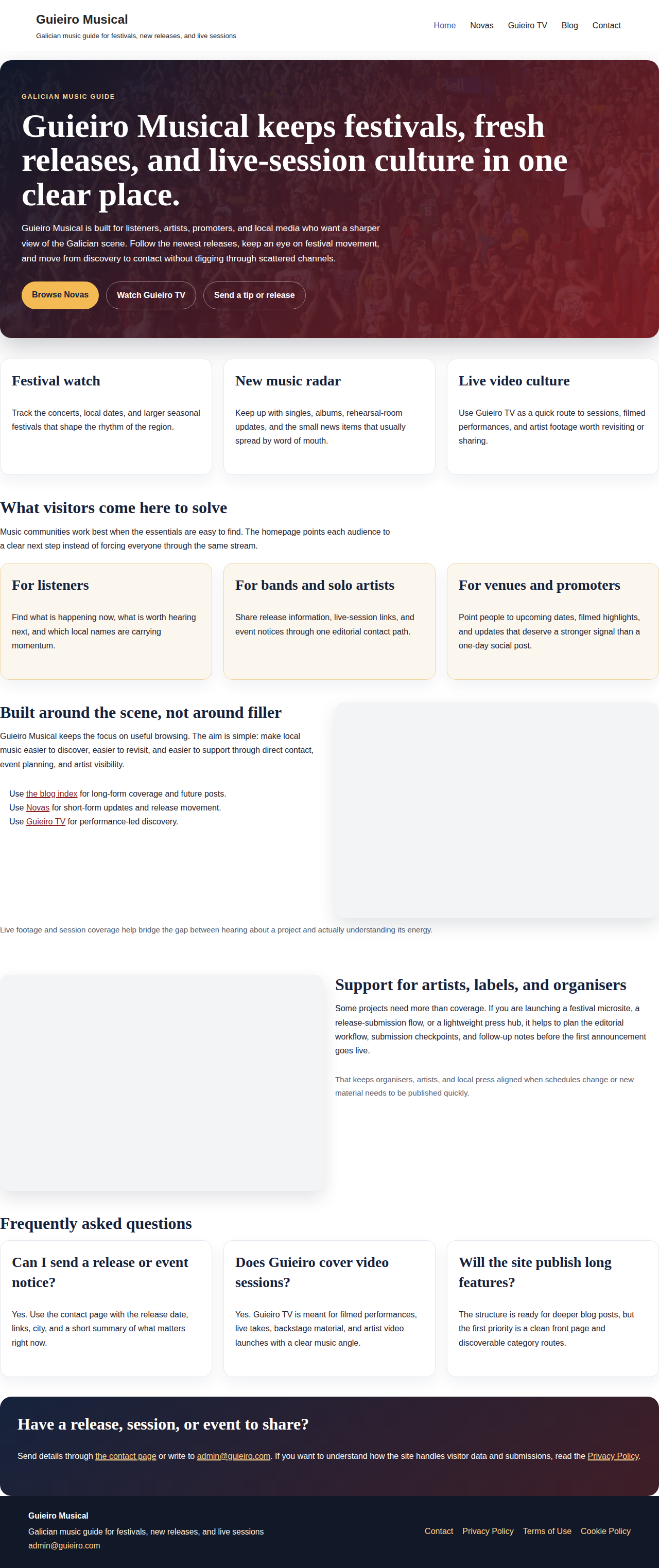
This kind of navigable layout—category sections, featured views, and clear entry points—helps you make decisions faster once you arrive. (If you already use Guieiro Musical, start by bookmarking the festival pages you care about before the day begins.)
Planning your schedule
A good multi-stage plan doesn’t try to “optimize every minute.” It creates priority windows and fallback options.
Step 1: Build a Plan A / Plan B list
For every overlap, decide:
- Plan A: the set you most want to be present for.
- Plan B: the alternative that still matches your mood (even if it’s not the “bigger” name).
Write them down as short bullets. The goal is not precision—it’s calm decision-making.
Step 2: Choose your “move time” buffers
Walking time is rarely just walking time. Add buffer for:
- crowd density changes
- finding your preferred viewing spot
- quick breaks (water, snacks)
Practical rule: if two sets overlap by 5–10 minutes, plan to catch the opening moments of your Plan A, then walk early toward your Plan B if you realize you’re sacrificing too much.
Step 3: Turn “popular acts vs. hidden gems” into a ratio
If you try to see every headliner and every discovery, you’ll end the day tired and regretful. Instead, pick a ratio like:
- 70/30: 70% priority picks, 30% exploration
- 60/40: more “digging,” especially if you’re attending multiple stages across days
Exploration isn’t random. It’s planned curiosity.
Balancing popular acts and hidden gems
Hidden gems usually aren’t hidden from the people who know what to look for—they’re just less crowded at the moment you arrive.
How to spot a set worth giving time to
- Follow the energy: if the crowd is engaged but not jammed shoulder-to-shoulder, that’s often a sweet spot.
- Look for stage identity: some stages lean more experimental or genre-pure.
- Check lineup context: collaborations, special guests, or “after” slots can be memorable even when they’re not promoted like headliners.
Make one “discovery reservation” per day
Pick one time block where you’ll try something you’re not fully sure about. If you love it, great. If you don’t, you still have momentum—you’ve already given yourself permission to explore.
Tips for staying energized
Staying energized is logistics, not willpower. If your plan includes recovery, you’ll enjoy more sets—not fewer.
Hydration and breaks (simple but non-negotiable)
- Start with water before you feel thirsty.
- Do a quick bathroom check after major transitions between stages.
- Use short “reset breaks” (5–15 minutes) rather than waiting until you’re exhausted.
Protect your hearing and your focus
Long festival days can blur together. Consider:
- ear protection if loud environments overwhelm you
- brief note-taking: one sentence per set you loved (so you remember what to revisit)
For more about general hearing-safety guidance, see CDC noise and hearing loss prevention.
Set expectations for overlaps
Overlaps aren’t a failure—they’re part of the format. When you’re choosing between sets, try a “right now” mindset:
- Which set fits the energy level you want in the next 30–45 minutes?
- Which set aligns with your Plan A priorities for the day?
- Which set will be easier to rewatch or revisit later via recordings?
Conclusion
Multi-stage festivals are a design problem: choices, movement, and time pressure. The easiest way to win is to plan priority windows, build Plan A / Plan B for overlaps, and keep at least one block for discovery. Add hydration and short reset breaks, and you’ll end the day energized instead of mentally frayed.
Try this next: open the festival lineup, pick 3 must-see sets, and write one discovery reservation. Then add one backup option for each overlap. That’s enough structure to enjoy the rest.
Key takeaways:
- Orient yourself to the layout and walking routes before choosing acts.
- Use priority windows and buffers—don’t schedule minute-by-minute.
- Balance popular acts with planned exploration (use a ratio).
- Plan recovery: hydration, short breaks, and quick reset moments.
- Treat overlaps as decisions, not problems.
Browse more festival and music guides